

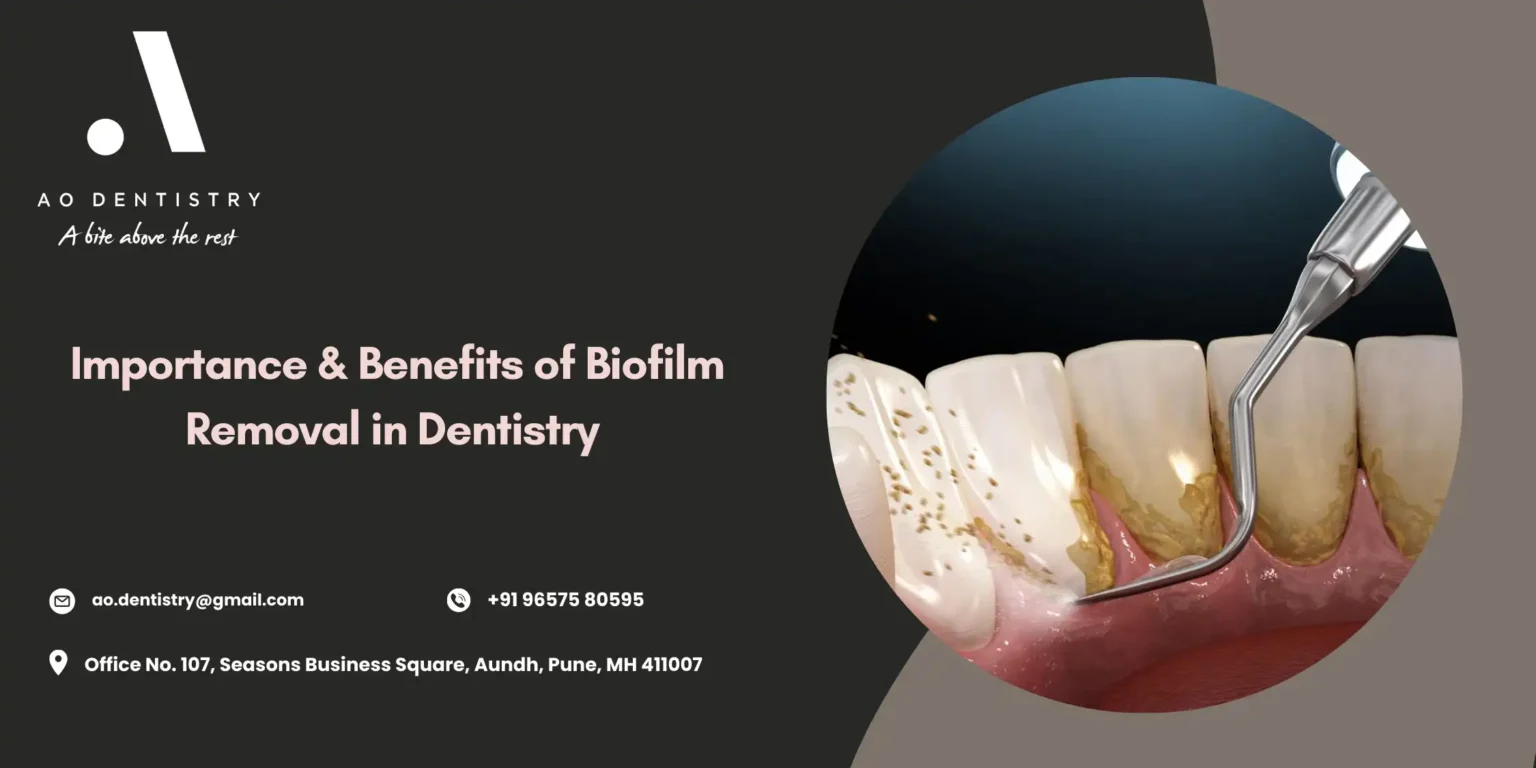
Do you think just brushing daily is enough? You brush daily twice, maybe floss occasionally and have figured it out. The problem is, there’s something happening on your teeth that regular brushing can’t address. It’s a bacterial layer called biofilm. It hardens into tartar. Your toothbrush becomes useless against it.
This is why people still end up with cavities and gum problems. Understanding biofilm matters more than most people realize.
Worried about root canal pain? Read Is RCT Painful.
Aligners vs Braces: Which Is the Best Option for Your Smile? Read more here
What is Dental Biofilm?
The terms plaque and biofilm are not the same. They aren’t replaceable with one another. Plaque is a soft layer that forms on tooth surfaces. Brush and it’s gone. Biofilm operates differently. Bacteria don’t just sit individually on teeth. They collectively form protective structures. They create a gel-like matrix around themselves. Research shows bacteria within biofilms communicate through chemical signaling something called quorum sensing. They work cooperatively as a unit. This organization makes biofilm fundamentally different from simple plaque.
Bacterial colonization happens constantly. These bacteria quickly start breaking down sugars and carbohydrates which results in acid and this acid directly attacks enamel surfaces throughout the day. Saliva provides some neutralization but when biofilm accumulates excessively saliva can’t keep pace. The biofilm layer gradually mineralizes and hardens into calculus, what people call tartar. Once calcified, mechanical toothbrushing cannot remove it. Professional intervention becomes necessary. This is the practical distinction between plaque and biofilm.
Here are a few home remedies for swollen gums
Why Biofilm Removal is Important
Untreated biofilm causes predictable consequences:
Your teeth get cavities – When bacteria produce acid, it wears down the enamel and causes small cavities. And fillings or root canal becomes necessary. Sometimes teeth have to be taken out.
Your gums start bleeding and swelling – Plaque irritates the gums around your teeth, leading to swelling and bleeding when you brush or floss. This is gum disease, and it gets worse if not treated.
You deal with constant bad breath – Anaerobic bacteria in biofilm produce volatile sulfur compounds creating persistent bad breath unresponsive to conventional mouthwash treatment.
Your overall health takes a hit – Research shows connections between gum disease and heart problems, strokes, diabetes complications. The bacteria from your mouth can enter your bloodstream through infected gums. Once in the bloodstream it causes inflammation and infections in other organs and tissues throughout your body.
You can lose your teeth – Advanced periodontal disease destroys bone supporting teeth. Teeth become loose. They fall out. This damage is irreversible.
Explore different Types of Crowns for Teeth here.
How to Use Mouthwash. Click here
Methods of Biofilm Removal
What You Can Do at Home
Fluoride toothpaste removes soft biofilm before mineralization. Interdental cleaning via flossing accesses areas toothbrushes cannot. Antimicrobial rinses suppress bacterial populations. These measures are essential. They cannot however remove mineralized calculus. Cannot access subgingival areas. Cannot reach proximal spaces in crowded dentitions. Home care forms a necessary foundation but proves insufficient for complete biofilm control.
Professional Cleaning Options
In traditional cleaning dentists use metal tools. Metal scalers scrape buildup. It works but patients don’t enjoy the experience. As the gums get irritated. Metal tools still can’t access every location where biofilm hides though. Guided Biofilm Therapy represents newer advancement. It uses EMS Airflow Prophylaxis Master machine combining pressurized air, warm water, and ultra-fine powder particles. Spray gently removes biofilm without mechanical scraping. Reaching areas traditional instruments simply cannot. Results in genuinely thorough biofilm elimination.
Stop cavities early with these Tooth Decay tips. Click here.
Professional Biofilm Cleaning: Step by Step
Biofilm disclosure – So the first thing the dentist does is put this colored dye on your teeth. It’s harmless. The dye sticks to the biofilm.Most people are kind of shocked by how many spots show up. Like, areas they thought were totally clean, there’s biofilm hanging out. It shows exactly where bacteria are thriving and where your daily brushing and flossing might need adjustment.
Patient education component – our dentist points out those stained spots. They tell you where your toothbrush isn’t reaching. Where your floss isn’t going. Which areas you completely miss. What specifically needs to change in how you brush and floss at home. It’s practical guidance so you can improve your routine.
Pneumatic spray decontamination – Air-powder-water spray systematically treats all surfaces including facial, lingual, occlusal, and interproximal areas. Biofilm is gently eliminated.
Subgingival pocket management – Specialized spray nozzle reaches periodontal pockets in patients with periodontitis. Thorough cleansing occurs without epithelial trauma or tissue cutting. Approach represents significant improvement over conventional scaling and root planing.
Refractory calculus removal – When calculus resists spray removal, ultrasonic instruments employing vibrational energy address resistant deposits. Vibration proves gentler than manual instrumentation.
Verification and clearance – Dentist inspects all surfaces confirming full biofilm removal
Fluoride protective application – Fluoride treatment hardens enamel and remineralizes incipient lesions.
Individualized recall scheduling – Patients receive personalized recall interval recommendations based on biofilm accumulation rate and periodontal risk assessment. Typical intervals range three to six months.
See what’s safe to eat after a Tooth Extraction.
Benefits of Regular Biofilm Removal
When you get biofilm removed regularly, things change. Your gums stop bleeding so much. Your gum line doesn’t recede as badly over time. You get way fewer cavities. Your teeth look whiter. Your breath stays fresh. And you’re protecting your overall health. You’re reducing your risk of serious health problems. It’s one of the best things you can do.
Here are a few ways to Stop Grinding Teeth Naturally.
Biofilm Removal vs Regular Cleaning
Routine cleaning addresses superficial plaque and visible debris. That’s basically all it does. Biofilm removal targets organized bacterial colonies actually responsible for cavities and periodontal disease. This distinction is critical. Surface cleaning is surface-level. Biofilm-focused treatment addresses the underlying cause. Patients receiving regular biofilm removal experience fewer cavities, healthier gums, superior long-term outcomes. You’re addressing disease source rather than manifestation.
FAQs
Q1. What is the importance of biofilm?
Ans. Biofilm removal prevents cavity development, halts periodontal disease progression, eliminates persistent bad breath, and significantly reduces systemic disease risk including cardiovascular pathology.
Q2. What happens if biofilm is not removed?
Ans. Biofilm undergoes mineralization forming calculus deposits with continued accumulation. Caries develop and progress. Periodontitis advances. Results into tooth loss.
Q3. What are the benefits of biofilm disruptors?
Ans. Disruptors compromise the protective biofilm matrix disrupting bacterial quorum sensing and survival mechanisms. This facilitates significantly more effective bacterial elimination than mechanical methods alone achieve.
Q4. Is biofilm harmful to humans?
Ans. Absolutely. It produces acids that destroy your teeth, creates gum disease, and can spread bacteria throughout your body causing inflammation and infection in other organs.
Q5. Is biofilm removal different from plaque removal?
Ans. Completely different processes. Plaque is soft and responds to mechanical toothbrush action. Biofilm is mineralized, organized, and highly resistant. Professional intervention required for proper removal.
Q6. What is an example of a biofilm commonly found in the human body?
Ans. Dental biofilm is the most prevalent example. Other biofilms form in urinary tract infections, respiratory infections, otitis media, and on prosthetic devices including orthopedic implants, cardiac devices, and other medical hardware.