

Worrying that a cheaper implant means a worse one is reasonable. Dental implants in India are affordable because of how clinics operate, not because the clinical work is cut down. The price falls, but the implant and the surgery around it do not.
The catch is that affordable and cheap are not the same thing. A well-run clinic lowers price safely, while a careless one cuts corners that surface years later. Knowing which cost factors are harmless, and which are warning signs, is an absolute necessity for every individual looking into this treatment option.
What Actually Makes Implants in India Cost Less
The price gap comes from structure, not from the implant. Several running costs are simply lower in India, and none of them touch the fixture or the surgery itself. These are the factors that genuinely move the figure.
- Clinic rent, staff salaries, and utilities cost far less in India, so the overhead built into every procedure is much smaller than in Western cities.
- Experienced centres that place implants and full-arch cases like All-on-4 or All-on-6 spread fixed equipment costs across a high volume of patients.
- Local purchasing power means a fair fee in rupees still looks low to a visitor who earns in dollars, pounds, or euros.
- A crowded, competitive market of qualified clinics keeps pricing honest, without anyone needing to drop clinical standards to win patients.
- Most care is paid for directly, which avoids the insurance and billing mark-up that quietly inflates dental bills in some countries.
- Crowns and prosthetics are made by skilled local laboratories, so there is no costly overseas outsourcing to recover from the patient.
- These savings are structural, so they repeat for every patient rather than depending on a one-off discount.
None of these is a shortcut. They are the ordinary economics of running a clinic in a lower-cost country, and they explain the price without explaining away the quality. The savings sit in the overheads, not in your jaw.
Why a Lower Price Does Not Mean Lower Quality
The implant fixture is a global product. Indian clinics fit the same internationally certified titanium and zirconia systems used in the West, often the very same brands. The screw placed in the jaw is identical, and only the cost of placing it changes.
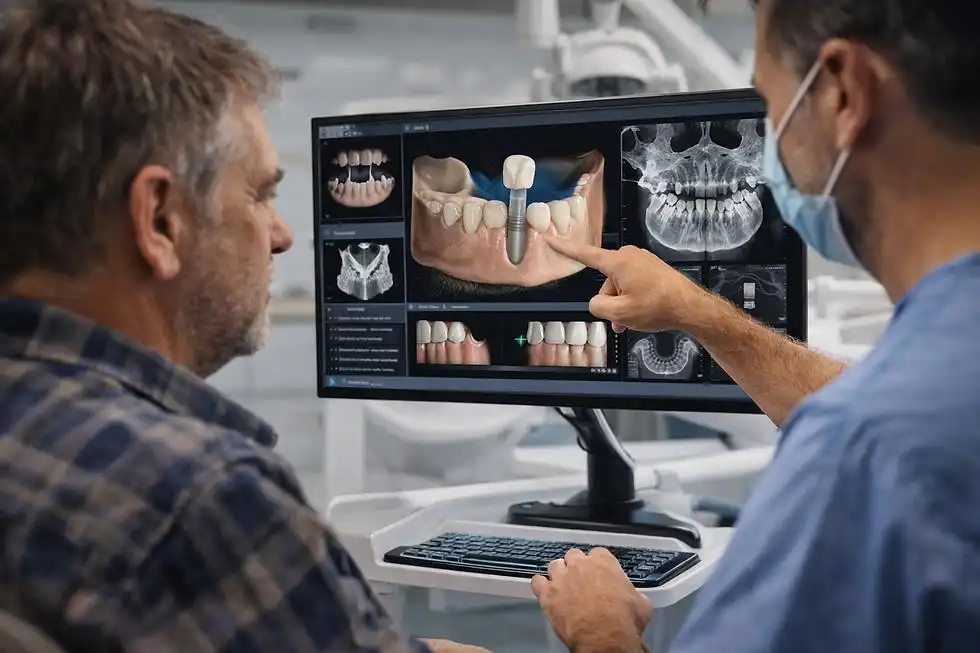
Placement quality rests on training and planning, both widely available here. Many implantologists hold postgraduate degrees and follow the same surgical protocols taught worldwide. A CBCT scan plans the implant in three dimensions before any incision is made.
Digital workflows such as intra-oral scanning and guided placement add precision, not cost-cutting. Sterilisation and infection control follow the same recognised standards used internationally. The fixture, the plan, and the surgeon decide the outcome, and geography changes none of them.
Long-term success rates in well-run Indian centres are comparable to international benchmarks, according to implant-dentistry bodies. A failure, when it happens, almost always traces back to planning, placement, or aftercare. It rarely traces back to the country the implant was placed in.
Most certified implant systems also carry a manufacturer warranty on the fixture, the same one honoured abroad. A reputable clinic registers the implant under that warranty and hands the patient the documentation. The guarantee travels with the brand, not with the postcode.
Where ‘Cheap’ Becomes a Real Risk
Affordable lowers the price safely, while cheap cuts the clinical corners that decide whether an implant lasts. The difference rarely shows on day one. It shows in the months and years afterwards, which is exactly when it is hardest and most expensive to fix.
- Unbranded or uncertified fixtures may lack the surface engineering and quality control that help an implant fuse properly with the surrounding bone.
- Placing an implant without a 3D scan risks poor angulation, nerve injury, or simply too little bone to hold it securely.
- Skipping a proper check of gum and bone health invites failure, because an implant set into active gum disease rarely integrates well.
- Complex work, from full-arch cases to implant-supported dentures, handled without a specialist raises the risk of malposition and early loss.
- Choosing the cheapest quote without comparing what each one includes often means paying again later for what was left out.
- No written warranty or follow-up means an early peri-implant infection can go unnoticed until the implant is already failing, when it is far harder to save.
How to Tell Affordable Apart From Cheap
The reassuring part is that the checks are simple and need no dental training. A few direct questions separate a well-run affordable clinic from a risky cheap one. Ask them before you commit, not after the work is done.
- Ask which implant system and brand will be used, and confirm it is an internationally certified one with a track record of published results.
- Ask to see the 3D-based plan, so placement is mapped to your actual bone rather than estimated by eye on the day.
- Confirm the treating dentist is a named, registered implantologist or oral surgeon with credentials you can verify on the Dental Council register.
- Ask about sterilisation, the warranty on the implant, and the follow-up planned for the months after surgery, not just the surgery itself.
- Ask whether the implant is registered under its manufacturer warranty, and request that paperwork in your own name.
- Treat a price that sits far below everyone else as a question to investigate, not a bargain to grab without asking why.
At AO Dentistry in Aundh, Pune, Dr Onkar plans implant cases with 3D imaging and certified systems, and shares the warranty and follow-up terms upfront. The implant is priced fairly because the practice runs efficiently, not because a clinical step was skipped. That distinction is the whole answer.
Frequently Asked Questions
Are dental implants in India lower quality because they cost less?
No. The lower price reflects local overheads, patient volume, and currency, not the implant or the surgery. Quality is set by the certified fixture, the planning, and the surgeon, and none of those cost factors touch any of them. The country lowers the bill, not the standard of the work.
Is it worth going to India for dental implants?
For many overseas patients it is, provided the clinic uses a certified implant system, plans with a 3D scan, and has a credentialed surgeon. The savings are genuine, but they only hold if the clinical steps stay intact. Verify those three things before you book any travel.
What is the number one reason dental implants fail?
Infection around the implant, called peri-implantitis, is a leading cause of late failure, while failed osseointegration causes early loss. The risk rises with smoking, poor oral hygiene, untreated gum disease, and weak surgical planning. Most of these causes are preventable with proper assessment and aftercare. Good planning prevents most failures.
Do affordable implants last as long as expensive ones?
With a certified fixture, correct placement, and good maintenance, longevity is comparable. When an implant fails early, the cause is usually placement, hygiene, or aftercare rather than the country it was placed in. The price alone does not decide how long an implant lasts. Country is not the variable here.
Are the implant brands used in India the same as in the West?
Yes, leading clinics use the same internationally certified titanium and zirconia systems. The fixture is a global product, so the brand placed in Pune can be identical to one placed in London or New York. Ask for the specific brand and confirm it in writing.
How can I judge implant quality without looking at the price?
Ask three things: the implant system and brand, whether a 3D scan is used to plan placement, and the surgeon’s credentials. Those answers predict quality far better than the fee ever could. A clinic that is confident in its work will answer all three readily.
Why are implants at some clinics or dental colleges even cheaper?
Lower overheads, training settings, or subsidised fees explain much of the difference. Supervised college care can be clinically sound, but it may trade away time, continuity, and operator choice. Cheaper is not automatically worse, nor automatically safe. Ask who will perform the surgery.
Does a cheaper implant always mean cheaper materials?
Not always, but it can, and the fixture is where corners are most quietly cut. An unbranded screw may look identical yet lack the tested surface that helps bone fuse to it. The only reliable way to know is to ask for the brand and grade in writing.
Can a failed cheap implant be fixed later?
Often it can, but revision is more involved and may need bone grafting and a fresh implant after healing. That makes a poorly placed cheap implant more expensive over its lifetime. Getting the first placement right is almost always the cheaper path in the end. Prevention beats revision every time.
What single thing most protects implant quality?
Proper diagnosis and planning, above all a 3D scan and a credentialed surgeon. The implant brand matters, but where and how it is placed matters more than which box it came from. Quality is decided in the planning, not at the checkout. Choose the planning, and the rest follows.
About this article
This article was medically reviewed by Dr Aneesha of AO Dentistry, Aundh, Pune. Clinical-standard points draw on the FDI World Dental Federation and WHO Oral Health guidance.
Conflict of interest: AO Dentistry is a dental practice and the publisher of this article, and places dental implants. This content is editorial and is not sponsored. It is general information, not a substitute for an in-person dental and radiographic assessment.